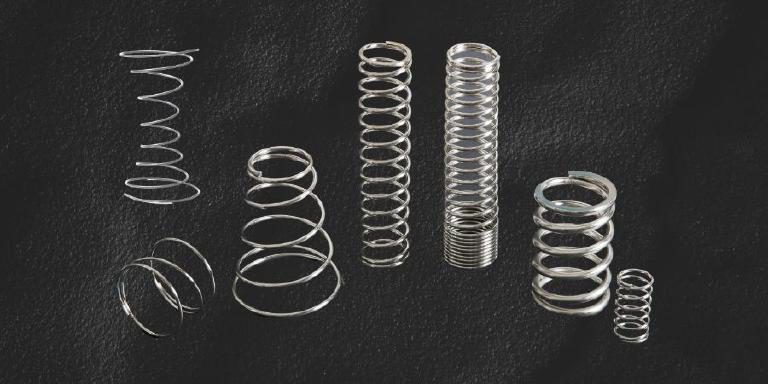
Compression springs work by following Hooke’s law, which states that the force exerted by a spring is proportional to its change in length. When a compression spring is compressed, it stores potential energy and tries to return to its original length. The amount of force and energy depends on the spring’s material, size, shape, and stiffness.
Different shapes and sizes of compression springs suit different purposes. Compression springs are essential for many mechanical systems, such as car suspensions, industrial machines, and household appliances.
Helical Compression Springs #
Helical compression springs are the most common type of compression springs. They are made of a helical coil of steel wire. These springs store potential energy when compressed and release it when the compressive force is removed. Helical compression springs are the most commonly used in a wide range of applications.
Key characteristics:
- Uniform coil diameter throughout the spring length
- Constant pitch between coils
- Linear force-deflection relationship
- Available in various wire diameters and materials
Common applications:
- Automotive suspension systems
- Industrial machinery
- Valve assemblies
- Medical devices
- Consumer appliances
Variable Pitch Compression Springs #
Variable pitch compression springs are designed with varying pitch or spacing between the coils. This design allows the spring to exert different amounts of force at different stages of compression. Variable pitch compression springs are often used in applications where a progressive or variable force is required.
Key characteristics:
- Non-linear force-deflection curve
- Progressive resistance as the spring compresses
- Reduced risk of resonance and buckling
- Better load distribution
Common applications:
- Automotive clutch systems
- Vibration isolation mounts
- Heavy-duty shock absorbers
- Progressive valve systems
Variable Diameter Compression Springs #
Variable diameter compression springs are a type of spring that has two or more diameters in a single spring. These springs provide specialized force characteristics for specific engineering requirements.
Conical Compression Springs #
Conical compression springs, also known as tapered springs, have a cone-shaped design. They are characterized by the varying diameter of the coils, which allows them to provide different rates of compression. This design allows conical compression springs to exert a more uniform force throughout their compression range. These springs are commonly used in applications where space is limited, such as in electrical switches, valves, and small mechanical devices.
Key characteristics:
- Tapered from larger to smaller diameter
- Nested coils allow for longer travel in compact spaces
- Progressive force response
- Reduced solid height compared to cylindrical springs
Common applications:
- Electrical contacts and switches
- Valve springs in limited spaces
- Battery contacts
- Push-button mechanisms
- Automotive clutch releases
Concave (Hourglass) Springs #
Concave compression springs, also known as hourglass springs or barbell springs, have a unique shape with a smaller diameter in the center and larger diameters at both ends. This design provides a variable rate of compression, making them suitable for applications requiring a gradual increase in force. Hourglass compression springs are commonly used in heavy-duty machinery, shock absorbers, and automotive suspensions.
Key characteristics:
- Smaller center diameter with larger ends
- Variable force response
- High load capacity
- Stable under compression
Common applications:
- Heavy-duty shock absorbers
- Automotive suspension systems
- Industrial machinery
- Railway equipment
- Load-bearing applications
Barrel (Convex) Springs #
Barrel springs, also known as convex springs, are a type of compression spring that has a larger diameter in the center than at the ends. This shape gives them several advantages over traditional compression springs, including increased load capacity, reduced buckling, and more compact design. Barrel compression springs are commonly used in heavy-duty machinery, shock absorbers, and automotive suspensions.
Key characteristics:
- Larger center diameter with smaller ends
- Increased stability and reduced buckling
- Higher load capacity
- Compact design for high-force applications
Common applications:
- Heavy-duty suspension systems
- Industrial presses
- Construction equipment
- Agricultural machinery
- High-load bearing applications
Material Selection for Compression Springs #
The performance and longevity of compression springs depend heavily on material selection. Common materials include:
- Music Wire (ASTM A228): High carbon steel with excellent fatigue resistance, suitable for general-purpose applications
- Stainless Steel (SS304/SS316): Corrosion-resistant, suitable for medical, food processing, and marine environments
- Chrome Silicon (ASTM A401): High-temperature applications with superior fatigue life
- Chrome Vanadium (ASTM A232): High-strength applications with good shock resistance
- Phosphor Bronze: Non-magnetic and corrosion-resistant, suitable for electrical applications
Engineering Considerations #
When selecting a compression spring for your application, consider:
- Load Requirements: Determine the minimum and maximum forces needed
- Deflection: Calculate the required travel distance
- Space Constraints: Consider available diameter and length
- Environment: Account for temperature, corrosion, and other environmental factors
- Cycle Life: Estimate the number of compression cycles required
- Spring Rate: Calculate the force per unit deflection needed
Conclusion #
Understanding the different types of compression springs and their characteristics is essential for selecting the right spring for your application. Whether you need a standard helical spring for general use, a conical spring for space-constrained applications, or a barrel spring for high-load scenarios, each type offers specific advantages that can optimize your design’s performance and reliability.
For custom compression spring manufacturing tailored to your specific requirements, consult with spring engineering specialists who can help you select the optimal design, material, and specifications for your application.