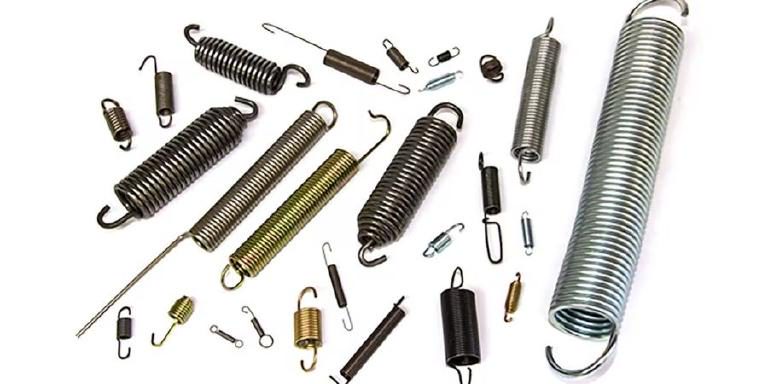
Extension springs rely on their hooks and loops to transmit force and perform their essential functions. The hooks and loops at both ends of the spring are critical for attachment to other components and determining how the spring behaves under load. These end configurations can be customized in various types to suit specific applications.
How Extension Spring Hooks Work #
When an external force pulls on the ends of an extension spring, the hooks transmit that force to the coiled body, causing the spring to extend and store energy. The design and position of the hooks directly affect:
- Load distribution across the spring body
- Stress concentration at the hook-to-body transition
- Mounting flexibility and alignment
- Maximum safe deflection
- Fatigue life and reliability
Hook Location Types #
Machine Hooks #
Machine hooks are the most widely used hook style, offering a strong and direct connection. They are formed by bending ¾ of a coil outwards, providing a robust anchor point for pulling forces.
Characteristics:
- Full coil bent at 90 degrees to form the hook
- Strong, direct force transmission
- Suitable for high-load applications
- Standard configuration for most industrial springs
Common applications:
- Industrial machinery
- Automotive suspension components
- Heavy-duty equipment
- General-purpose tension springs
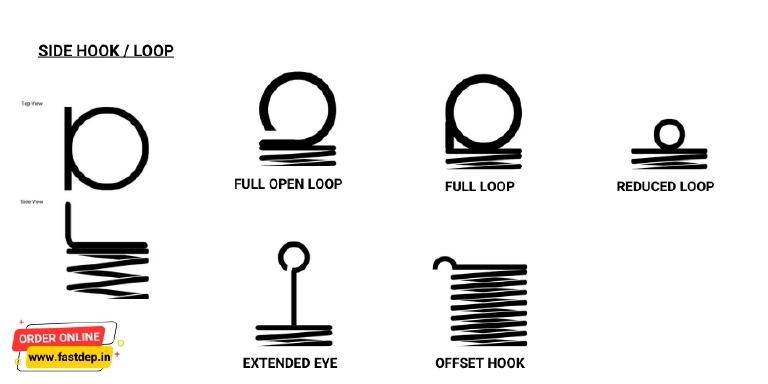
Side Loops (Cross-Over Hooks) #
Side loops, also known as cross-over hooks, are positioned over one side of the spring body, offering a more compact design. They are particularly useful when space is limited or when the spring needs to be offset from its center.
Characteristics:
- Hook formed on the side of the spring body
- Compact profile for space-constrained applications
- Reduced stress concentration compared to full hooks
- Allows for offset mounting
Common applications:
- Compact mechanical assemblies
- Space-constrained mechanisms
- Light to medium load applications
- Offset mounting requirements
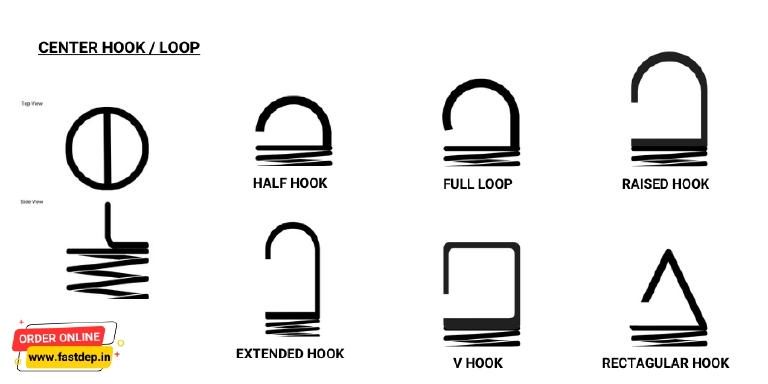
Center Loops #
Center loops are hooks attached to the center of an extension spring. They are commonly used in applications where it is important to maintain a balanced load distribution across the spring body.
Characteristics:
- Hook attached at the center point of the end coil
- Balanced load distribution
- Symmetric force application
- Reduced tendency for spring body rotation
Common applications:
- Balanced tension systems
- Symmetric loading applications
- Precision instruments
- Medical devices
Extended Hooks #
Extended hooks extend further away from the spring body, providing a longer reach and more leverage for pulling forces. They are often used in applications where space is not a constraint and where a stronger pulling action is required.
Characteristics:
- Hook extends beyond the normal spring body diameter
- Increased leverage for pulling forces
- Longer reach for remote attachment points
- Higher stress at the hook-to-body transition
Common applications:
- Remote attachment points
- High-leverage mechanisms
- Agricultural equipment
- Construction machinery
Custom Hook Shapes #
Beyond the standard position types, many different shapes of hooks or loops can be used for extension springs, depending on the design and requirements of the application. Common custom hook shapes include:
- German eyes: Full loop formed at the end, providing 360-degree attachment
- English eyes: Half-loop configuration for specific mounting needs
- Tang hooks: Extended straight section for precise adjustment
- Reduced hooks: Smaller hooks for miniature spring applications
- Double hooks: Two hooks at 180 degrees for balanced loading
Custom hook shapes can be manufactured to meet specific engineering requirements. Manufacturers can produce hooks based on CAD drawings or physical samples to ensure exact fit and function.
Engineering Considerations for Hook Design #
When selecting or designing extension spring hooks, consider these engineering factors:
-
Stress Concentration: The hook-to-body transition is the highest stress point. Proper design reduces fatigue failure risk.
-
Hook Orientation: The direction the hook faces affects mounting and load application. Ensure hooks align with the force direction.
-
Material Selection: Hook strength must match the spring body. Common materials include music wire, stainless steel, and chrome silicon.
-
Heat Treatment: Proper heat treatment after hook formation ensures consistent strength and fatigue resistance.
-
Surface Finish: Hook surfaces should be smooth to prevent stress risers and crack initiation.
-
Manufacturing Tolerances: Hook dimensions must be controlled to ensure proper fit and function in the assembly.
Hook Selection Guide #
| Hook Type | Best For | Space Requirements | Load Capacity |
|---|---|---|---|
| Machine Hook | General industrial use | Moderate | High |
| Side Loop | Compact assemblies | Low | Medium |
| Center Loop | Balanced loading | Moderate | Medium |
| Extended Hook | Remote attachment | High | High |
| Custom Shape | Specialized applications | Varies | Varies |
Conclusion #
Understanding the different types of extension spring hooks and loops is essential for selecting the right spring configuration for your application. The hook type affects not only how the spring attaches to your assembly but also how forces are transmitted, how stress is distributed, and ultimately how long the spring will last in service.
For custom extension spring manufacturing with specialized hook configurations, consult with spring engineering specialists who can help you select the optimal hook design, material, and specifications for your specific application requirements.