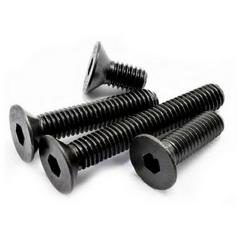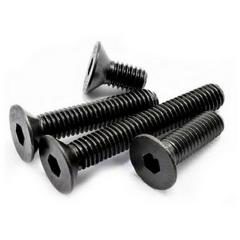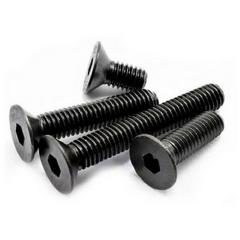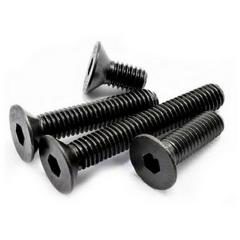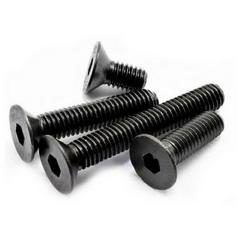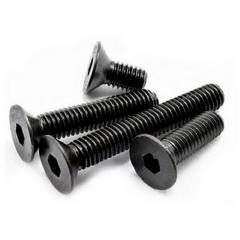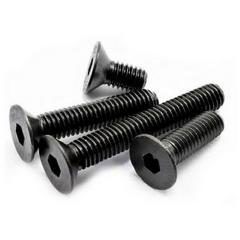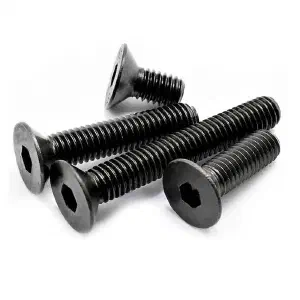
Allen Countersunk Socket Screws
Flat-head fasteners with internal hex drive and 90° conical bearing surface per DIN 7991 / ISO 10642. Designed for flush-mounting in countersunk holes, eliminating protrusions on aerodynamic surfaces, sliding interfaces, and visible panels.
Specification
#
Standard
DIN 7991 / ISO 10642 (EN ISO 10642)
Material
Alloy Steel
Thread
Coarse (standard)
Grade
12.9
Coating
Black oxide
Head Type
Countersunk (flat head) with hexagon socket, 90° included angle
Drive Type
Hexagon socket (Allen key/hex wrench)
Stock
In stock
Dimension
#
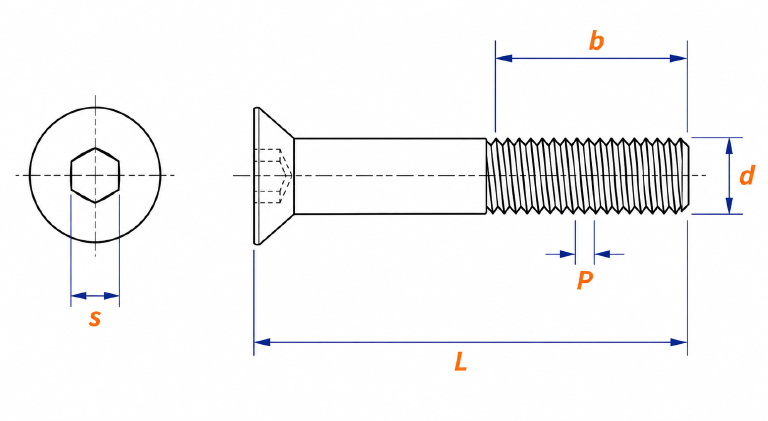
Size (d mm)
Thread Dia (min-max mm)
Pitch
Length (mm)
Thread Length (mm)
M3
2.87-3.00
0.5
6-30
18
M5
4.85-5.00
0.8
8-50
22
M6
5.85-6.00
1.0
10-60
24
M8
7.83-8.00
1.25
12-80
28
M10
9.82-10.00
1.5
16-100
32
- All dimensions in mm, tolerance +/- 0.01 mm. Additional dimensions available on request.
Benefits
#
Countersunk socket screws solve the problem of fastener head protrusion on surfaces that must remain flush for functional or aerodynamic reasons. The conical head seats fully within a prepared countersink, creating a continuous flat surface that eliminates drag, interference with mating components, and snagging hazards.
In machine tool construction, flush-mounted fasteners prevent interference with workpieces and fixtures sliding across table surfaces. Aerospace and automotive applications benefit from reduced aerodynamic drag on skin panels. The hex socket drive allows installation from one side in confined assemblies. Available in property classes 8.8 through 12.9, countersunk socket screws provide selectable strength for both general-purpose and dynamically loaded joints, though designers must account for reduced loadability inherent to the head geometry.
Common Applications
#
Countersunk socket screws are specified where the fastener head must sit flush with or below the material surface.
- Aerospace skin panels and aerodynamic surfaces
- Machine tool ways and sliding surfaces
- Precision fixture and jig plates
- Conveyor and material handling surfaces
- Architectural metalwork and facades
- Bicycle frame and component assemblies
- Hydraulic manifold plates
- Mold and die parting surfaces
- Cover plates requiring flush fasteners
Read Me
| Standard | DIN 7991 / ISO 10642 (EN ISO 10642) |
| Material | Alloy Steel |
| Thread | Coarse (standard) |
| Grade | 12.9 |
| Coating | Black oxide |
| Head Type | Countersunk (flat head) with hexagon socket, 90° included angle |
| Drive Type | Hexagon socket (Allen key/hex wrench) |
| Stock | In stock |
| Size (d mm) | Thread Dia (min-max mm) | Pitch | Length (mm) | Thread Length (mm) |
|---|---|---|---|---|
| M3 | 2.87-3.00 | 0.5 | 6-30 | 18 |
| M5 | 4.85-5.00 | 0.8 | 8-50 | 22 |
| M6 | 5.85-6.00 | 1.0 | 10-60 | 24 |
| M8 | 7.83-8.00 | 1.25 | 12-80 | 28 |
| M10 | 9.82-10.00 | 1.5 | 16-100 | 32 |