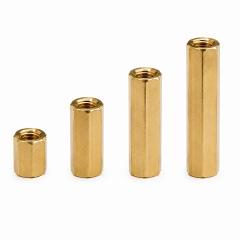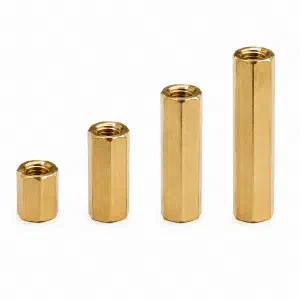
M3 Brass Hex Spacer
M3 brass hex spacers are precision-engineered female-to-female threaded separators with a hexagonal profile, used to maintain exact spacing between components in electronic and mechanical assemblies while providing electrical conductivity for grounding paths.
Materials
#
Brass (CW614N / CuZn39Pb3 / C36000 free-machining)
Selection Guide
#
Choose brass when electrical conductivity for grounding/EMI shielding is required, non-magnetic properties are needed for sensitive instruments, or operating temperatures exceed nylon limits (+200°C vs +80–100°C). Choose stainless steel for higher structural loads, harsher corrosion environments, or sustained high-temperature service. Choose nylon for electrical insulation, weight savings, or cost-sensitive low-load applications. Choose aluminium when weight is critical and anodized insulation is acceptable; brass offers superior thread durability and corrosion resistance unplated. Verify plating (natural, nickel, tin) per environment — nickel extends corrosion resistance to C3–C4 industrial/coastal classes.
Installation Guidance
#
Typical torque range: 0.5–0.8 Nm for brass M3 (lubricated). Verify for specific variant/grade — nickel-plated may require slightly higher torque. Do not exceed 1.0 Nm. Recommended tools: 5.5 mm hex key/wrench/spanner, torque wrench for controlled tightening, thread gauge (verify M3 × 0.5 mm pitch). Thread locker: Optional low-strength (e.g., Loctite 222) for vibration environments. Avoid high-strength threadlockers on brass — may cause stripping on removal. Reuse: Typically 3–5 assembly cycles before thread degradation. Inspect threads for wear/galling before reuse.
Environmental & Compliance
#
Typical operating temperature: -50°C to +200°C (varies by material/grade/coating; nickel plating extends upper limit). Corrosion resistance: unplated brass suitable for indoor/C1–C2 environments; nickel-plated (5–12 μm) suitable for C3–C4 industrial/coastal; not recommended for prolonged salt spray/marine immersion without additional protection. Chemical resistance: good to oils, fuels, alcohols, mild acids/bases; poor to ammonia/amines (stress corrosion cracking), strong acids (nitric, hydrochloric), mercury. Nickel plating improves chemical resistance broadly. Compliance that may apply: RoHS Directive 2011/65/EU (standard C36000/CW614N meets RoHS; low-lead variants available), REACH Regulation EC 1907/2006 (SVHC disclosure on request), DFARS 252.225-7014 on request for defense contracts, EN 10204 Type 3.1 material certificates typically available, Type 3.2 on request, ISO 9001/IATF 16949 manufacturing quality systems typical, MIL-STD/ASME compliance per manufacturer.
Benefits
#
M3 brass hex spacers solve multiple engineering challenges in electronic assemblies: they prevent short circuits between PCBs and metal chassis by providing controlled stand-off height (5–30 mm typical), create airflow channels for passive thermal management, maintain connector alignment under vibration, and establish a conductive grounding path between board and chassis. The hexagonal profile allows secure wrench tightening — critical in vibration-prone industrial, automotive, and aerospace environments where hand-tightened round spacers loosen. Brass threads resist stripping far better than nylon, support 3–5 reuse cycles, and machine to ±0.1 mm length tolerances for repeatable stack heights. Nickel plating extends corrosion resistance to industrial/coastal environments while maintaining conductivity. RoHS/REACH compliance with EN 10204 3.1 traceability satisfies regulated industry requirements.
Common Applications
#
Electronics assembly — PCB board-to-board stacking
#
Problem: Short circuits between PCB traces and metal chassis; inadequate airflow causing thermal throttling; connector misalignment from board flex
Solution: Brass hex spacer raises PCB 5-25mm off chassis, providing electrical isolation via stand-off height and creating airflow channels for passive cooling while maintaining connector alignment
Key spec: M3 thread, 5-30mm length, conductive brass for grounding path, 5.5mm A/F for wrench tightening
Electronics assembly — Motherboard mounting in computer cases
#
Problem: Motherboard contact with case causing shorts; vibration loosening screws; need for grounding path to chassis
Solution: M3 brass hex spacers thread into case standoffs, motherboard screws into spacer tops, brass conductivity provides chassis ground path
Key spec: M3 thread, 6-10mm typical height, nickel-plated for corrosion resistance, conductive brass
Industrial automation — Control panel component separation
#
Problem: Terminal blocks, relays, and PLC modules need precise spacing for wiring access and heat dissipation; vibration in industrial environments loosens assemblies
Solution: Hex brass spacers provide rigid mounting with wrench-flats for secure tightening, conductive material aids EMI shielding
Key spec: M3 thread, 10-20mm length, 5.5mm A/F hex, brass for conductivity and vibration resistance
Telecommunications — RF module and antenna mounting
#
Problem: RF components require precise spacing for impedance matching; non-magnetic materials needed to avoid field distortion; grounding continuity required
Solution: Non-magnetic brass spacers maintain exact board-to-chassis distance, conductivity provides RF ground reference
Key spec: M3 thread, precise length tolerance ±0.1mm, non-magnetic brass, 5.5mm A/F
Medical devices — Diagnostic equipment PCB stacking
#
Problem: Multiple PCBs in compact enclosure need reliable spacing; cleaning/sterilization requires corrosion-resistant materials; RoHS compliance mandatory
Solution: Nickel-plated brass spacers resist cleaning agents, RoHS-compliant C36000/CW614N alloy, precise lengths for stack height control
Key spec: M3 thread, 8-15mm length, nickel-plated brass, RoHS/REACH compliant, EN 10204 3.1 traceability
Aerospace and defense — Avionics panel and chassis assembly
#
Problem: High vibration environments require secure thread engagement; weight constraints favor compact designs; temperature extremes from -55°C to +85°C
Solution: Hex brass spacers with full thread engagement, good strength-to-weight, wide temperature range, non-magnetic for sensitive instruments
Key spec: M3 thread, 5-20mm length, brass (CW614N), temp range -50 to +200°C, non-magnetic
Test and measurement — Fixture and jig construction
#
Problem: Test fixtures need repeatable, precise spacing for probe alignment; frequent assembly/disassembly cycles; conductivity for signal integrity
Solution: Machined brass hex spacers with tight tolerances (±0.1mm), reusable threads rated for multiple cycles, conductive for signal path
Key spec: M3 thread, custom lengths available, ±0.1mm tolerance, brass for conductivity and thread durability
Automotive electronics — ECU and sensor module mounting
#
Problem: Under-hood vibration and thermal cycling; space-constrained enclosures; EMI shielding requirements; 125°C operating temps
Solution: Compact M3 brass hex spacers with nickel plating for corrosion resistance, conductive for EMI ground, vibration-resistant hex drive
Key spec: M3 thread, 6-12mm length, nickel-plated brass, high temp capability, 5.5mm A/F
Compatibility Notes
#
Typically mates with M3 male threaded fasteners (socket head, pan head, hex head), M3 hex nuts and lock nuts, M3 flat washers (DIN 125/ISO 7089), M3 spring lock washers (DIN 127), and M3 thread-forming screws for plastic. Multiple spacers can be stacked for increased height; ensure total thread engagement per spacer remains ≥6mm. Use washers between spacers to distribute load. Avoid coarse-thread M3.5 or mismatched thread classes (6g/6H mismatch). Avoid stainless steel screws without anti-seize (galvanic corrosion risk). Do not use with tapered pipe threads (NPT/BSPT).
Common Failure Modes
#
- Thread stripping — caused by over-torquing brass threads beyond recommended range (typically >1 Nm for M3)
- Galling — dry assembly without lubrication, especially stainless steel screw into brass spacer; use anti-seize or lubricant
- Stress corrosion cracking — exposure to ammonia/amines/ammonium compounds on susceptible brass alloys (traditional leaded brass)
- Corrosion/pitting — prolonged exposure to humid/saline environments without adequate plating; dezincification in aggressive water
- Dimensional creep — not typical for brass at room temperature; possible at elevated temps >150°C under sustained load
- Electrical contact degradation — oxidation of unplated brass surfaces increases contact resistance over time
Frequently Asked Questions
#
Maximum torque for M3 brass hex spacer
#
Typically 0.5–0.8 Nm for lubricated brass M3 threads. Nickel-plated variants may tolerate slightly higher torque. Do not exceed 1.0 Nm to avoid thread stripping.
EMI/RFI shielding effectiveness of brass spacers
#
Brass provides good electrical conductivity (~28% IACS) for EMI grounding paths. For effective shielding, ensure continuous conductive contact between PCB, spacer, and chassis — use conductive washers and verify surface finish (nickel plating maintains conductivity while improving corrosion resistance).
Difference between spacer (F/F) and standoff (M/F)
#
A spacer (female-female) has internal threads on both ends and requires a screw from each side. A standoff (male-female) has a male stud on one end and internal thread on the other, allowing it to thread directly into a tapped hole or another standoff. Spacers suit through-bolt assemblies; standoffs suit blind-hole or stacked configurations.
Available plating options and their purposes
#
Natural (as-machined): standard yellow-gold appearance, lowest cost. Nickel plated (5–12 μm): improved corrosion resistance (C3–C4), silver appearance, maintains conductivity. Tin plated: solderable surface for grounding connections. Gold plated: high-reliability contacts, maximum corrosion resistance.
Custom length and thread combinations
#
Custom lengths from 5–80 mm available from most manufacturers. Mixed thread combinations (e.g., M3 × M4, metric × inch) possible as special order. Minimum order quantities typically apply for non-standard configurations.
Material certifications (EN 10204 3.1/3.2)
#
EN 10204 Type 3.1 mill certificates typically available from reputable suppliers, providing chemical composition and mechanical property verification. Type 3.2 (third-party witnessed) available on request for critical applications.
RoHS/REACH compliance documentation
#
Standard C36000/CW614N free-machining brass meets RoHS Directive 2011/65/EU. Low-lead variants available for stricter requirements. REACH SVHC disclosure provided on request. Documentation typically supplied with shipment.
Thread depth vs body length selection
#
Minimum thread engagement of 6 mm per end recommended for M3. Select body length = required spacing + 2× thread depth (12 mm total engaged). Verify screw length does not bottom out in spacer before clamping assembly.
Galvanic corrosion with stainless steel screws
#
Brass (anodic) + stainless steel (cathodic) in presence of electrolyte creates galvanic cell accelerating brass corrosion. Mitigate with: nickel plating on spacer, anti-seize compound on threads, insulating washers, or use same-material fasteners (brass screws).
Temperature limits for brass spacers
#
Typical range -50°C to +200°C. Nickel plating extends upper limit slightly. Above 150°C sustained load may cause creep. Not suitable for continuous service above 200°C — consider stainless steel.
Common Buying Mistakes
#
- Confusing spacer (female-female) with standoff (male-female) — different assembly methods
- Selecting incorrect length (body length vs overall length confusion)
- Not specifying plating requirement (natural vs nickel vs tin)
- Overlooking minimum thread engagement depth for the application
- Using brass where higher strength (steel/stainless) is required
- Not requesting material certifications for regulated industries
- Assuming all M3 spacers have same A/F (some manufacturers use 5 mm or 6 mm)
- Ignoring lead content in standard brass for RoHS-critical applications
- Not accounting for galvanic corrosion with stainless fasteners
- Ordering unplated brass for outdoor/humid environments
Related Products
#
Also see:
M3 Brass Hex Standoff (male-female)
,
M4 Brass Hex Spacer
,
M5 Brass Hex Spacer
,
M6 Brass Hex Spacer
,
M3 Nylon Hex Spacer
,
M3 Stainless Steel Hex Spacer
,
3mm Aluminium Round Spacer
,
5mm Aluminium Round Spacer
Read Me
Solution: Brass hex spacer raises PCB 5-25mm off chassis, providing electrical isolation via stand-off height and creating airflow channels for passive cooling while maintaining connector alignment
Key spec: M3 thread, 5-30mm length, conductive brass for grounding path, 5.5mm A/F for wrench tightening
Solution: M3 brass hex spacers thread into case standoffs, motherboard screws into spacer tops, brass conductivity provides chassis ground path
Key spec: M3 thread, 6-10mm typical height, nickel-plated for corrosion resistance, conductive brass
Solution: Hex brass spacers provide rigid mounting with wrench-flats for secure tightening, conductive material aids EMI shielding
Key spec: M3 thread, 10-20mm length, 5.5mm A/F hex, brass for conductivity and vibration resistance
Solution: Non-magnetic brass spacers maintain exact board-to-chassis distance, conductivity provides RF ground reference
Key spec: M3 thread, precise length tolerance ±0.1mm, non-magnetic brass, 5.5mm A/F
Solution: Nickel-plated brass spacers resist cleaning agents, RoHS-compliant C36000/CW614N alloy, precise lengths for stack height control
Key spec: M3 thread, 8-15mm length, nickel-plated brass, RoHS/REACH compliant, EN 10204 3.1 traceability
Solution: Hex brass spacers with full thread engagement, good strength-to-weight, wide temperature range, non-magnetic for sensitive instruments
Key spec: M3 thread, 5-20mm length, brass (CW614N), temp range -50 to +200°C, non-magnetic
Solution: Machined brass hex spacers with tight tolerances (±0.1mm), reusable threads rated for multiple cycles, conductive for signal path
Key spec: M3 thread, custom lengths available, ±0.1mm tolerance, brass for conductivity and thread durability
Solution: Compact M3 brass hex spacers with nickel plating for corrosion resistance, conductive for EMI ground, vibration-resistant hex drive
Key spec: M3 thread, 6-12mm length, nickel-plated brass, high temp capability, 5.5mm A/F